
By Mike Collopy, CFP®, CIMA®
October 2025
Private equity plays an extremely important role in our world, from directly and indirectly employing millions of people, to disrupting industries with new technology, driving growth and more. From an investors standpoint private equity can be a valuable part of a portfolio. But considering the changing landscape, investors should handle private equity decisions with care, focusing on selectivity, discipline, and having realistic return expectations.
Private Equity Investment Basics
Historically, private equity (PE) has been reserved for high-net-worth investors and institutions. The goal is straightforward: to boost portfolio returns and diversify away from public markets.
Because private funds invest directly in businesses that aren’t listed on stock exchanges, they’ve traditionally required high minimums and strict investor qualifications, such as minimum net worth of $1million or $5million, depending on the fund. That exclusivity contributed to private equity’s mystique of higher hurdles, but also the promise of higher rewards.
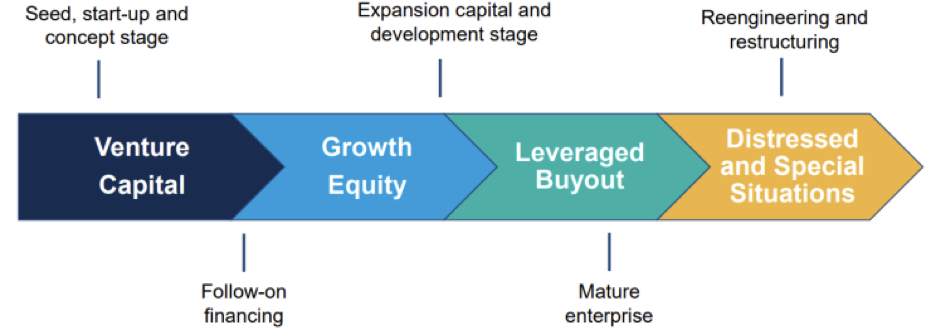
Private equity investments occur across the life cycle of a company, and most PE funds focus on a particular stage. Shown below are the various segments, each with its own risks and characteristics. For example, Venture Capital targets early-stage companies high risk, high reward, and not uncommon for some investments to go to zero. Leveraged Buyouts, on the other hand, involve more established businesses with steadier cash flow and generally lower risk.
The key point: private equity covers a broad spectrum of investment types, and understanding those differences along with how you’re being compensated for the risk is essential.
A Changing Landscape
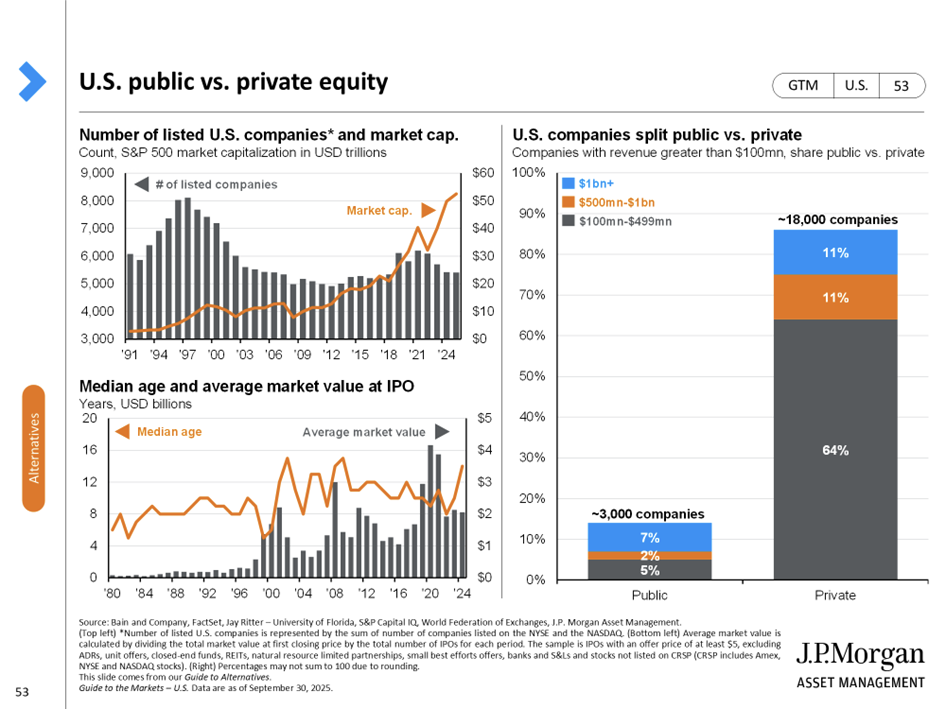
The number of public companies has steadily declined, while the private market has exploded, as shown below. Entrepreneurs like Elon Musk and Sam Altman have cited the advantages of staying private: fewer quarterly distractions, more flexibility, and long-term focus. Their companies, SpaceX and OpenAI, are worth more than many of our largest public firms here in Atlanta, such as Home Depot or Coca-Cola.
In short, more successful companies are choosing to stay private longer, leaving the public markets narrower and potentially less opportunistic.
As private markets expand, investment firms catering to individual investors have created a new generation of funds that hold private equity and other alternative investments. These newer vehicles feature lower minimums and lighter qualifications, opening access to a much broader audience.
Adding to this shift, an executive order signed by President Trump recently opened the door for alternative investments (including private equity) to appear in 401(k) retirement plans. There’s still plenty of work for regulators like the SEC before that happens, but the momentum is building.
It’s no surprise investors want in. The pitch is compelling: participate in the next generation of fast-growing, industry-defining companies that may never go public, with the potential for higher returns than traditional markets.
What Lies Beneath
Beneath that allure, however, are structural risks that don’t always get equal attention.
First, valuations are stretched in private markets similar to public markets. Deal multiples remain high, while rising borrowing costs have squeezed returns. Attractive opportunities draw heavy demand and high prices rarely favor new investors.
Second, and most importantly, private equity is illiquid. You generally cannot sell out quickly, and sometimes you can’t sell at all. Most PE funds have 10-year terms, but it’s become increasingly common for managers to extend funds to 12, 14, or even 15 years through what are called extension clauses or continuation vehicles. These structures allow managers to hold investments longer, but they also keep investors’ capital locked up far beyond the original expectation.
That lack of liquidity is supposed to earn investors a “premium” or higher returns for tying up their money. Yet in practice, those excess returns have been inconsistent.
One of the most cited studies, by Harris, Jenkinson, and Kaplan (Journal of Investment Management, 2016), found that pre-2006 U.S. buyout funds outperformed public equities by roughly 3%–4% per year. More recent funds, however, have merely matched the market. In other words, the “illiquidity premium” has mostly disappeared in the past decade.
The Performance Gap
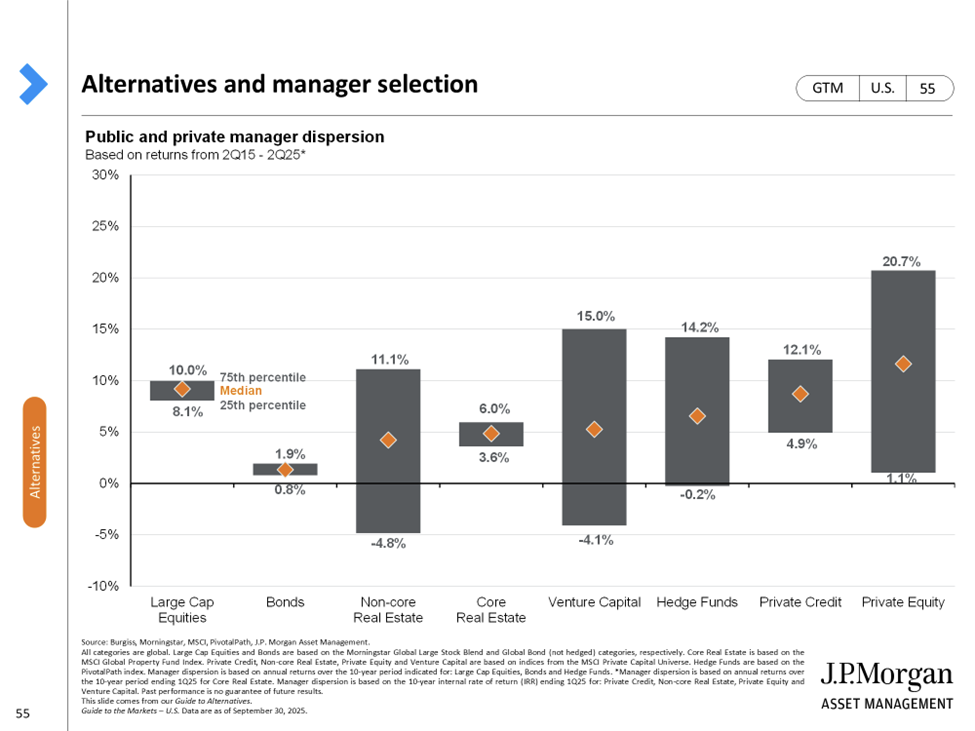
Private equity’s headline performance hides a critical truth: returns vary dramatically by manager.
As shown below, top-quartile managers have delivered average annual returns around 20%, while bottom-quartile managers have returned barely 1%. In public equities, by comparison, that performance gap is much narrower, typically 8%–10% across quartiles.
This means success is less about being in private equity and more about choosing the right fund and manager.
That raises an important question: will 401(k) plans and retail investors have access to the top managers? Time will tell.
Key Takeaways
-
- Be selective: The difference between a top fund and an average fund is enormous. Manager choice, track record, and discipline matter far more than the asset class itself.
- Expect illiquidity: Most private equity investments are locked up for 10 years, sometimes longer.
Many funds now use extensions or continuation vehicles to hold assets past their original timelines. - Know what you’re getting: The best-performing managers and strategies are unlikely to appear in
retail or 401(k) vehicles. Broader access doesn’t necessarily mean access to quality. - Temper return expectations: With valuations high and borrowing costs elevated, future returns are likely to be lower than historical returns. Lower doesn’t mean bad, but financial plans should reflect today’s realities, not yesterday’s optimism.
Private equity can still play a meaningful role for long-term investors. But the environment has changed. Success will depend less on access to the asset class and more on manager selection, being selective and patient.
Written by Mike Collopy
DISCLOSURE:
Advisory services offered through Veracity Capital, LLC, a registered investment advisor. Information presented is for educational purposes only and does not intend to make an offer or solicitation for the sale or purchase of any specific securities, investments, or investment strategies. Investments involve risk and, unless otherwise stated, are not guaranteed. Be sure to first consult with a qualified financial advisor and/or tax professional before implementing any strategy discussed herein. Past performance is not indicative of future performance.
Investing in alternative assets involves higher risks than traditional investments and is suitable only for sophisticated investors. Alternative investments involve greater risks than traditional investments and should not be deemed a complete investment program. They are not tax efficient and an investor should consult with his/her tax advisor prior to investing. Alternative investments have higher fees than traditional investments and they may also be highly leveraged and engage in speculative investment techniques, which can magnify the potential for investment loss or gain. The value of the investment may fall as well as rise and investors may get back less than they invested.
This performance report provides information regarding the accounts managed by Veracity Capital, LLC, in accordance with your investment objectives. You should communicate any changes to your current investment objectives or financial condition to Veracity Capital, LLC.
Past performance is not indicative of future performance. Principal value and investment return will fluctuate. No guarantees or assurances that the target returns will be achieved, or objectives will be met, are implied. Future returns may differ significantly from past returns due to many different factors. Investments involve risk and the possibility of loss of principal. The values and performance numbers represented in this report do not reflect management fees. The values used in this report were obtained from sources believed to be reliable. Veracity Capital, LLC, calculated performance numbers using data provided. Please consult your custodial statements for an official record of value.
This information may be taken, in part, from external sources. We believe these external sources to be reliable, but no warranty is made as to accuracy. This material is not financial advice or an offer to sell any product. There is no guarantee of the future performance of any Veracity Capital, LLC, portfolio. The investment strategies discussed may not be suitable for all investors. Before investing, consider your investment objectives and Veracity Capital, LLC, charges and expenses. All investment strategies have the potential for profit or loss.
Benchmarks: The index / indices used by Veracity Capital, LLC, have not been selected to represent an appropriate benchmark to compare an investor’s performance, but rather are disclosed for informational purposes. Detailed information regarding the indices is available upon request. The volatility of the indices may be materially different than that of the portfolio.
Veracity Capital, LLC, is a registered investment advisor. Registration does not imply a certain level of skill or training. More information about Veracity Capital, LLC, including its advisory services and fee schedule, can be found in Form ADV Part 2 which is available upon request.